
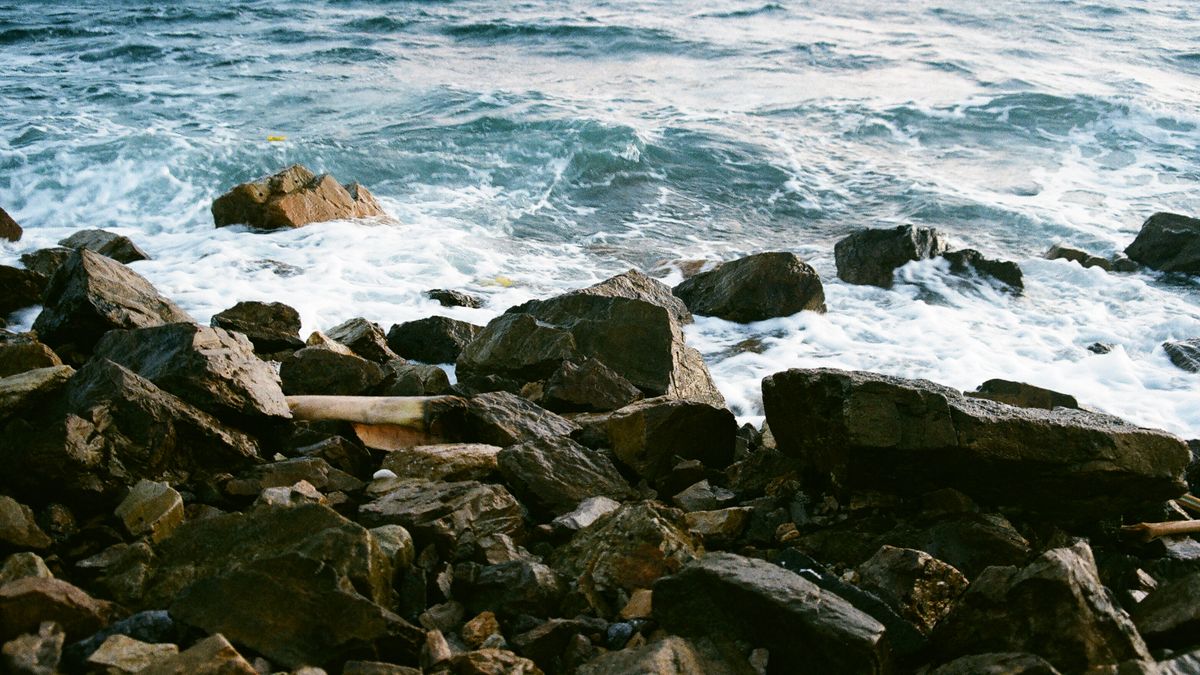
Exposed coastlines have their own weather. A forecast for the nearest inland town can be gently wrong by the time you reach a headland, where wind funnels between cliffs and a sea breeze can swing the direction through ninety degrees in an hour. Check the forecast on the morning itself, but treat it as a hint rather than a promise. Look at wind speed and direction, the timing of the tide, and whether rain is expected to arrive as a front or as scattered showers. A front means a defined band, which you can sometimes time your walk around. Scattered showers over a warm sea mean convection, and convection means the possibility of thunder.
Learn a handful of sky signals. A flat, dark shelf of cloud advancing off the sea is a squall line, and it will arrive faster than it looks. Towering clouds with a flattened, anvil-shaped top are cumulonimbus, the storm-makers. A sudden drop in wind, an odd stillness, or a sharp fall in temperature on a summer afternoon are all warnings. So are gulls and oystercatchers flying inland in numbers. If the horizon turns bruised and flat-topped, you have less time than your eyes suggest.
The kit that saves a walk is small and cheap. The trick is carrying it on the calm, bright days too, because those are the days that catch people out.
On a cliff path, an escape route is rarely another cliff path. It is a footpath heading inland, a farm track, a slipway, a lane down to a village, or a gateway through a wall. Identify these as you go, at every headland, and count them. Say to yourself: "If it turns now, I go back to the gate at the second cattle grid."
Coastal heritage is often your friend here. Old churches, chapels, coastguard cottages, lime kilns and the remnants of pilchard cellars tend to sit where people once needed access to the sea and back again. Where you find them, you usually find a track. Where the path runs close to an undercut edge, or where the cliff is crumbling and unfenced, note it and keep inland. Then tell someone your route and your expected return time, and stick to it.
The hardest decision on an exposed coast is the one that ends the walk early. Make it easier by setting a turnaround time before you start, not when you're tired and three miles from the car. Then use simple tests. If the wind is strong enough to push you sideways, or the sea has turned white and noisy, or you would not start this walk now if you were standing at the beginning, turn around.
Be especially careful about descending into coves and bays. They feel sheltered on the way down and become traps on the way back, when the only exit is a steep climb with no cover. Pride is not a safety tool. A short walk finished dry is worth more than a long one finished in a storm.
Get off ridges, summits and open cliff tops. Do not go down a cliff face to escape weather; people are hurt doing exactly that. Move inland and descend gently if you can. Shelter in a dip in the ground, behind a solid wall, or beside a low rock outcrop well away from the edge.
Storms are what shaped these coastlines in the first place. They have taken clifftop churches, swallowed harbour walls and moved whole beaches along the shore. Walking here with one eye on the sky is not timidity; it is the same respect that built the sea walls and the lifeboat stations. Go out, enjoy the light and the long views, and come home with a story rather than a rescue. The coast will still be there next weekend.

Hi, my name is Anthony kuber. I am artist and fashion designer.
I love to travel and writing blogging.
Your email address will not be published. Required fields are marked *
Software Developer & Writer
Hey, I'm Diva, a developer and writer blending code and creativity. I'm driven by a deep curiosity and a relentless pursuit of excellence. Join me as I craft digital solutions and captivating stories.


